The short plan: 12 steps to the first cup
Opening a coffee shop is easiest to think of as a chain in which each decision rests on the one before. The format decides the space, the space decides the equipment, and the equipment and menu decide the budget and the team. The most expensive beginner mistake is signing a lease or buying an espresso machine before the numbers are done, which is why the numbers come second in this plan.
The order of opening
| Step | What to do | Outcome |
|---|---|---|
| 1. Format | Takeaway, seating, or seating with a kitchen | You know the space and team you need |
| 2. Numbers | Start-up budget and break-even point | How many cups a day you must sell |
| 3. Space | Check footfall, power, water, ventilation, lease | A lease without surprises |
| 4. Registration | Sole trader (IP) or LLC (OsOO) | Registration certificate |
| 5. Tax | Choose a regime with your accountant | You know what to pay and when |
| 6. Fiscal register | Connect and register a KKM | You can issue fiscal receipts |
| 7. Sanitary | Staff medicals, sanitary and fire rules | Ready for an inspection |
| 8. Equipment | Bar and counter | The bar brews, the till prints |
| 9. Menu | Suppliers, recipes, cost, prices | A menu with a clear margin |
| 10. Team | Hire and train baristas | People and a shift rota |
| 11. Software | Menu, stock and staff in the POS | Every sale is recorded |
| 12. Launch | Trial day, soft opening, first month | You trade and see the numbers |
Step 1. Choose the format
A takeaway counter needs the least money but lives entirely on footfall. A café with seating earns from guests who stay for a second drink and a pastry, but pays for floor space, furniture and cleaning. A café with a kitchen raises the average bill with breakfasts and lunches, and adds a cook, ventilation, cold storage and much stricter sanitary requirements. If you are unsure, start smaller: growing from takeaway to seating is easier than shrinking a room you have already leased.
Step 2. Run the numbers before signing a lease
Split the budget into one-off costs (fit-out, equipment, furniture, first stock, signage, rent deposit) and monthly costs (rent, wages, utilities, supplies, tax, software). Keep a reserve for several months of fixed costs: a new café takes time to be found, and early revenue is almost always below plan.
Then work out your break-even point: monthly fixed costs divided by what is left from one bill after cost of goods. For example, suppose fixed costs are 300 000 KGS a month, the average bill is 250 KGS and cost of goods is 30%. Each bill leaves 175 KGS, so you need about 1 715 bills a month, or about 57 a day. These are illustrative figures; replace them with your own, and remember that turnover tax and waste push the number up.
Step 3. Find and check the space
Count footfall outside the door in the morning, at lunch and in the evening, on a weekday and at the weekend. Then check the space like an engineer: the electrical capacity allocated to it, water and drainage where the bar will go, ventilation if you will cook, storage and supplier access, whether signage is allowed (check outdoor advertising rules with the city hall), and lease terms on rent increases, repairs and use as a legal address.
Step 4. Register: sole trader or LLC
Most single-owner coffee shops register as a sole trader (IP). The tax service registers sole traders; a Kyrgyz citizen needs only an original passport, and the application can be filed at the tax office where you live, are registered or will trade, or online in the taxpayer account at cabinet.salyk.kg. The certificate is usually issued within three working days. Since early 2026 the same account also lets you re-register online: switch tax regime, add activities or move to another tax district when your legal address changes.
An LLC (OsOO) suits partners, investors or a planned chain. Legal entities are registered by the justice authorities, now also online with an electronic or cloud signature. A new LLC is placed on the general tax regime by default; to switch, it applies to the tax office within 15 calendar days of registration, so plan this with your accountant.
Step 5. Choose a tax regime
Small businesses can use the general regime or a special regime such as the single tax, which is charged on revenue rather than profit. A law signed on 6 August 2026 sets the single tax for catering at 5% in Bishkek and Osh and 3% elsewhere; confirm the start date and conditions with your accountant or the tax service. Patents for trade were abolished on 1 July 2024, and we found no clear official answer on patents for coffee shops, so do not count on one without written confirmation from the tax service.
Step 6. Connect a fiscal register
A coffee shop must give guests a fiscal receipt. Since 1 July 2021, as a general rule, only fiscal registers (KKM) that send data to the tax service in real time may be used, connected through the tax service's KKM Online system or a fiscal data operator. In February 2026 the tax service reminded catering businesses that a pre-bill or a screenshot of the order is not a fiscal receipt; businesses in the government pilot must use special fiscal software, the rest must use registered registers.
A fiscal register and café software do different jobs. Ordo prints regular customer receipts, not fiscal ones, and runs alongside your fiscal register without replacing it.
Step 7. Sanitary rules, medicals and fire safety
The mandatory sanitary approval before opening has been abolished, and current law does not require you to notify the sanitary authority when you start. Sanitary standards still apply and inspections can happen; a draft law published in summer 2026 would allow unannounced checks of high-risk premises. Staff who handle food must have regular medicals; under Government Resolution No. 418, from 1 September 2026 the results are kept in an electronic medical book. Check the specific rules for your premises with the local sanitary authority and fire safety with the Ministry of Emergency Situations before you fit out.
Step 8. Coffee shop equipment checklist
Buy equipment after the menu and bar layout are fixed. Instead of prices, which vary by brand and supplier, here is what to ask the seller. Also check that the model has a service centre and spare parts in Bishkek.
Coffee shop equipment
| Item | Why | What to look for |
|---|---|---|
| Espresso machine | Espresso and milk drinks | Group heads for peak traffic, power draw, local service and parts |
| Espresso grinder | Consistent grind and taste | Speed and dose accuracy; a second grinder for decaf |
| Water filter | Taste and scale protection | Test your water, plan cartridge changes |
| Under-counter fridge | Milk and desserts | Capacity for a day of trade |
| Sink or dishwasher | Clean cups at peak | Water and drainage in place |
| Scales, tamper, jugs | Accurate recipes | Scales to 1 gram with a timer |
| Computer or tablet | Taking orders | Keeps working if the internet drops |
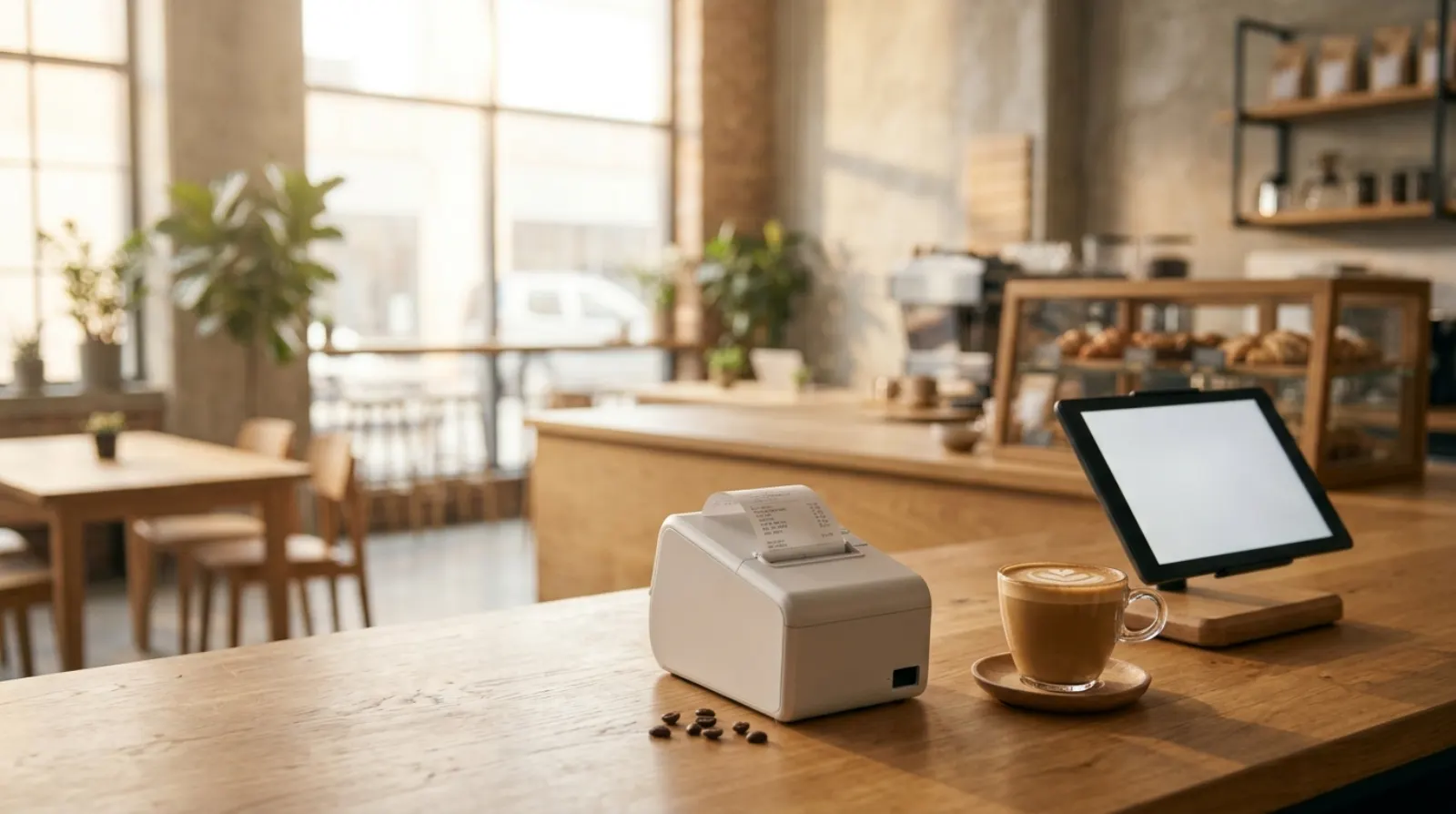
| Thermal receipt printer | Receipts and bar tickets | 58 or 80 mm, ESC/POS, USB |
| Cash drawer | Cash | Connects to the receipt printer |
| Card terminal | Card payments | Bank terms; the POS marks the payment as card |
| Fiscal register | Fiscal receipts | Real-time data transfer, registration |
| Wi-Fi router | Tablets and bar screen | Separate guest network, backup internet |
Step 9. Suppliers, menu and cost
Keep the menu short: espresso classics, filter coffee, tea, a couple of signature drinks and a small pastry case. Choose a roaster by tasting samples on your own equipment, and line up a backup supplier for milk, pastries and cups. Write a recipe for every item with grams and millilitres, and work out the cost per cup with our calculator before setting prices.
Step 10. Hire and train the team
Hire for attitude and care, then train the craft. Staff the morning peak more heavily than quiet hours, write short standards for recipes, opening and closing, deliveries and what to do when the internet or printer fails, and train everyone on trial days. Give each person their own POS login with role-based rights; in Ordo, discounts above the limit and refunds need the owner's PIN.
Step 11. Software you need from day one
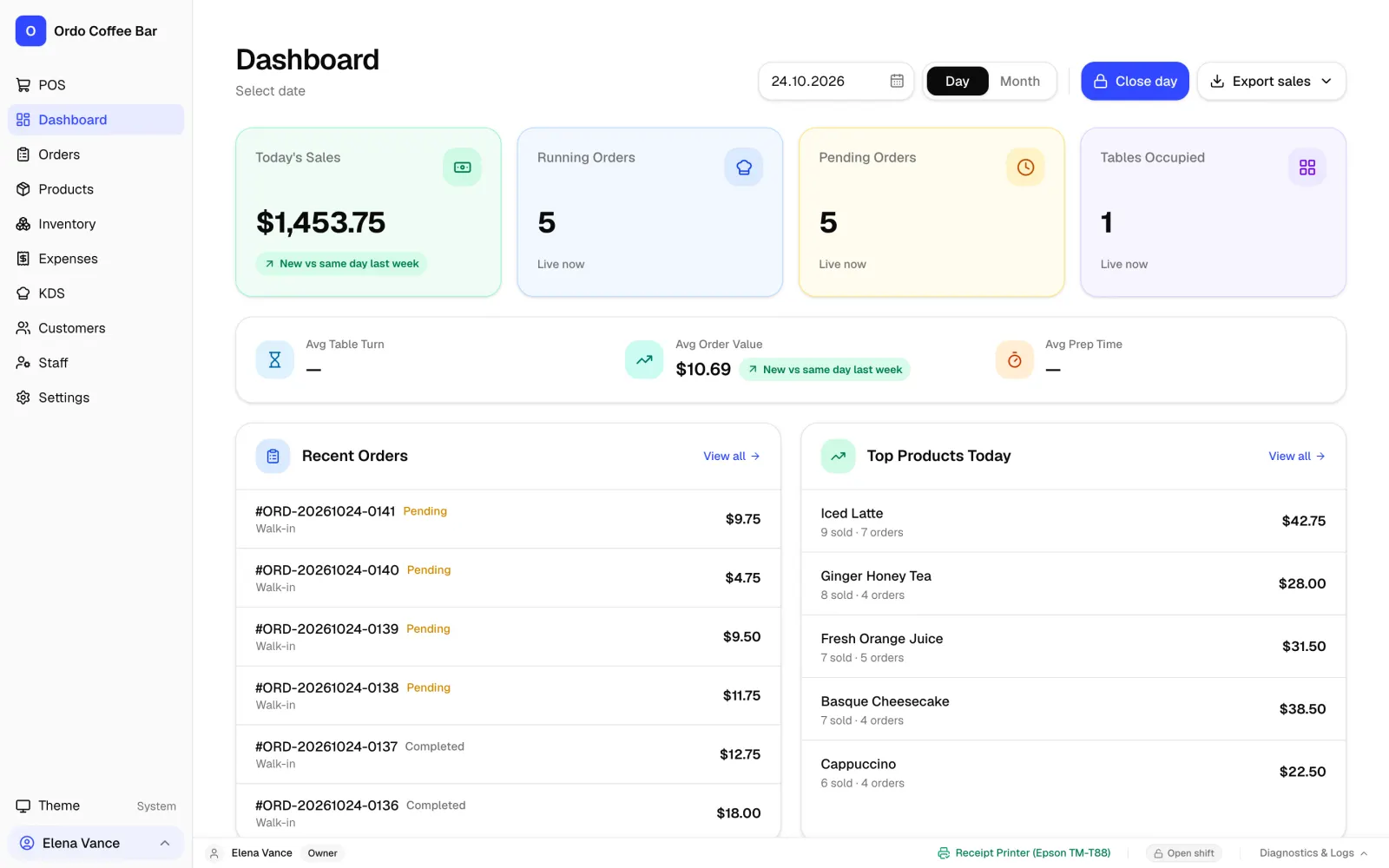
You need a till, a bar screen, recipe-based stock, shifts with a cash count, and reports. Compare the full cost, not just the subscription, and check what happens when the internet drops.
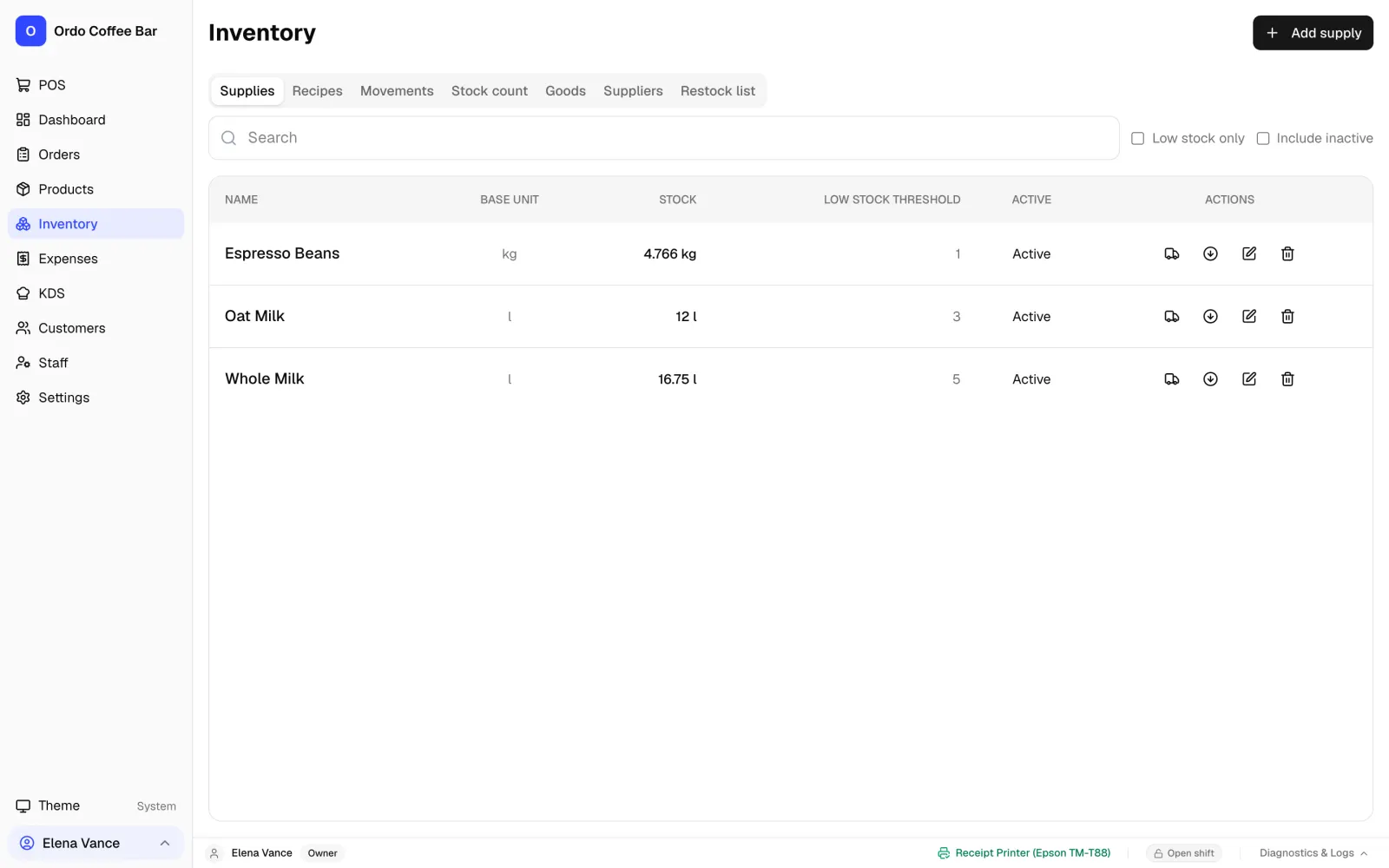
- The Ordo app for Windows or Linux keeps data on the café computer and keeps selling offline; tablets and phones join over the café Wi-Fi in a browser.
- Orders appear on the bar screen as soon as they are paid.
- Each sale deducts ingredients by recipe; Ordo warns about low stock and prints a shopping list.
- Shifts start with a float and end with a cash and card count; daily totals and Telegram alerts.
- 58 and 80 mm ESC/POS USB printers, a cash drawer via the printer and any bank's card terminal.
- All of this for 1990 KGS a month per café (about 23 US dollars), any number of devices, with a 14-day free trial and no card.
Launch checklist and the first month
Before opening: registration and tax regime done, staff medicals valid, fiscal register registered, recipes dialled in, menu and opening stock in the POS, printer, cash drawer and card terminal tested, the till tested with the internet off, and a trial day run with the cash and card totals matching the shift report.
In the first month, reconcile cash and card totals every evening, watch the number of bills and the average bill against your break-even point, check low stock daily, and review best sellers, sales by hour and recipe variance weekly.
FAQ
Where do I start when opening a coffee shop from scratch?
With the format and the numbers. Decide between takeaway, seating or a kitchen, and work out how many bills a day you need to break even. Only then look for a space and buy equipment.
Sole trader or LLC for a coffee shop in Kyrgyzstan?
For one café with one owner, a sole trader is usually simpler: the tax service registers it and you can apply online. An LLC suits partners or a planned chain. Discuss the tax side with an accountant.
What tax does a coffee shop in Bishkek pay?
A law signed in August 2026 sets the single tax for catering at 5% in Bishkek and Osh and 3% in other regions. Confirm the start date and conditions with the tax service or your accountant.
Does a coffee shop need a fiscal register?
Yes. Guests must get a fiscal receipt, and the register must send data to the tax service in real time. A pre-bill or a screenshot does not count.
Do I need a sanitary permit to open?
The mandatory sanitary approval before opening has been abolished, but sanitary standards apply and inspections can happen. Staff need regular medicals, recorded in an electronic medical book from 1 September 2026.
Does Ordo replace a fiscal register?
No. Ordo prints regular customer receipts and runs alongside your fiscal register for orders, the bar screen, stock, shifts and reports.
Sources
- Economist.kg: registering a sole trader in Kyrgyzstan (in Russian) — checked 2026-10-29
- Economist.kg: online sole trader re-registration (in Russian) — checked 2026-10-29
- Economist.kg: registering a business in Kyrgyzstan (in Russian) — checked 2026-10-29
- Economist.kg: online registration of legal entities (in Russian) — checked 2026-10-29
- Economist.kg: new single tax rates (in Russian) — checked 2026-10-29
- Economist.kg: trade patents abolished from 1 July 2024 (in Russian) — checked 2026-10-29
- Economist.kg: online fiscal registers from 1 July 2021 (in Russian) — checked 2026-10-29
- Economist.kg: tax service on fiscal receipts in catering (in Russian) — checked 2026-10-29
- Economist.kg: draft law on sanitary inspections (in Russian) — checked 2026-10-29
- Economist.kg: medical books move to electronic format (in Russian) — checked 2026-10-29