
What a coffee shop business plan must answer
A business plan answers three questions with numbers: how much money you need to open and survive the first months; how many customers a day you need to break even; and how many months it takes to get the investment back. The sections below follow that order, and the numbers from each step feed the next, like a spreadsheet.
- format and location;
- customers and competitors;
- menu, cost per serving and average ticket;
- start-up costs;
- fixed monthly costs and variable costs;
- revenue in three scenarios;
- break-even and payback;
- risks and what to measure in the first three months.
Step 1. Format, location and customers
The example is a 25 m² coffee shop with a bar counter and six seats, open 30 days a month, with two baristas working shifts while the owner handles purchasing, money and social media.
Choose the location by foot traffic, not by how nice the space looks. Stand outside on a weekday morning between 8 and 10, count passers-by every 15 minutes, and note how many already carry a coffee cup. Then visit five to seven coffee shops within a 10–15 minute walk and write down their format, cappuccino and americano prices, food offer and queue at peak time. You are looking for what customers nearby are missing, not for something to copy.
Step 2. Menu, cost per serving and average ticket
Keep the menu short: 8–12 drinks, a few desserts and maybe two takeaway food items. Work out the cost of each serving with our coffee cost per cup calculator: in its example a 180 KGS cappuccino costs about 62 KGS to make, around 35% of the price.
Calculate the average ticket from the basket, not from your best seller. Say 70% of customers buy only a drink at about 190 KGS and 30% buy a drink and a dessert at about 370 KGS: 0.7 × 190 + 0.3 × 370 = 244 KGS. We round it to 250 KGS below.
Step 3. Start-up costs
Start-up costs are everything you pay before the first customer. Keep a separate reserve for the first months: many coffee shops close not because the idea was bad but because the money ran out in month three.
Start-up costs for a small coffee shop (example, KGS)
| Item | Amount, KGS |
|---|---|
| Espresso machine | 400,000 |
| Two grinders | 150,000 |
| Under-counter fridge and display case | 120,000 |
| Water filter and bar tools | 60,000 |
| Fit-out and bar counter | 350,000 |
| Furniture for six seats and signage | 150,000 |
| Computer or tablet, receipt printer, cash drawer | 50,000 |
| Fiscal cash register | 25,000 |
| Registration and paperwork | 20,000 |
| Rent deposit and first month | 120,000 |
| First stock order | 80,000 |
| Menu, branding, launch promotion | 50,000 |
| Total investment | 1,575,000 |
| Reserve: 3 months of fixed costs | 570,000 |
| Total money needed | 2,145,000 |
All amounts are an example for the calculation, not market prices. Replace each line with a real quote.
Step 4. Monthly costs
Fixed costs are paid whatever you sell: rent, wages, utilities, software, the accountant. Variable costs grow with sales: ingredients and cups, a tax on turnover, and the bank's card fee. You need to separate them to find break-even.
In the example fixed costs are 190,000 KGS a month: rent 60,000, two baristas 70,000, payroll contributions 12,000, utilities 12,000, internet 2,000, Ordo 1,990, accountant 8,000, machine service 4,000, cleaning 5,000, marketing 10,000 and other 5,010. The owner's own pay is not included.
Variable costs are 38% of revenue: ingredients and cups 32%, single tax 5%, card fees about 1% (say half of customers pay by card and the bank charges 2%; ask your bank for its rate). According to economist.kg, in August 2026 Kyrgyzstan set the single tax rate for food service at 5% in Bishkek and Osh and 3% elsewhere, charged on turnover rather than profit. Check the start date and whether this regime suits you with the tax service or your accountant. So 62% of every som of revenue, or 155 KGS of a 250 KGS ticket, is left for fixed costs and profit.
The 32% is an optimistic assumption. If drinks cost 29–36% of their price and a dessert about 42% of its price, the basket from step 2 comes to about 36%. At 36% each ticket leaves 145 KGS and you need 44 tickets a day to break even instead of 41 (see step 6); at 38% it leaves 140 KGS and you need 46. Either raise prices or bring serving costs down, and recalculate after every price change from a supplier.
Step 5. Revenue in three scenarios
Revenue = tickets per day × average ticket × 30 days. Profit = revenue × 0.62 − 190,000 KGS, before the owner’s pay.
Monthly revenue and profit at a 250 KGS average ticket (example)
| Scenario | Tickets per day | Revenue per month, KGS | Profit per month, KGS |
|---|---|---|---|
| Cautious | 50 | 375,000 | 42,500 |
| Base | 80 | 600,000 | 182,000 |
| Good | 110 | 825,000 | 321,500 |
Step 6. Break-even and payback, step by step
Break-even revenue = 190,000 ÷ 0.62 ≈ 306,500 KGS a month. Tickets per month = 190,000 ÷ 155 ≈ 1,226, or about 41 a day. At a 200 KGS ticket you would need 52 a day, at 300 KGS 35, at 350 KGS 30, so raising the average ticket is often the easiest lever.
Simple payback in the base scenario is 1,575,000 ÷ 182,000 ≈ 8.7 months. With a realistic ramp-up of 40, 55 and 70 tickets a day in the first three months, those months return about 197,000 KGS, and the remaining 1,378,000 takes another 7.6 months: about 11 months in total. In the cautious scenario payback takes over three years; in the good one about five months.
Risks and what to measure in the first three months
The main risks are traffic below plan, rising ingredient prices, waste at the bar, depending on one barista, rent changes and machine breakdowns. For each, write down the number that will warn you and what you will do.
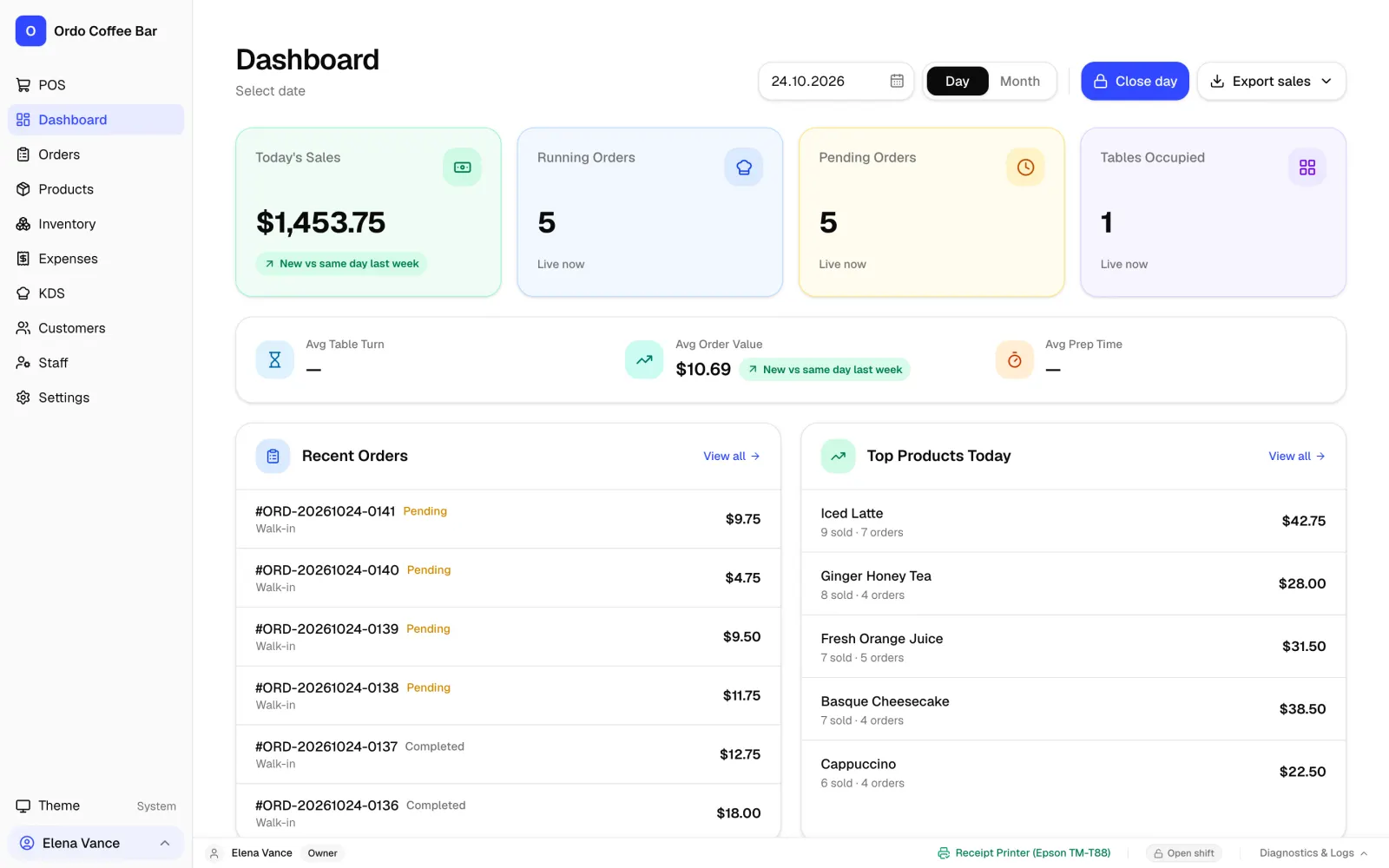
Each week compare five numbers with the plan: tickets per day, average ticket, ingredient cost as a share of revenue, sales by hour and day of the week, and cash left in reserve. In Ordo each sale deducts ingredients by recipe, and the dashboard shows revenue, best sellers and average ticket, plus ingredient cost, gross profit and gross margin for any period. Shift reports and low-stock alerts arrive in Telegram when there is an internet connection. Ordo costs 1990 KGS a month per café (about 23 USD) with any number of devices and keeps selling offline. Its receipts are not fiscal; it works alongside your fiscal register.
FAQ
How much does it cost to open a coffee shop?
It depends on the format, premises and equipment. In our example the investment is about 1.6 million KGS plus a reserve of about 0.6 million KGS, but these are example figures; replace them with real quotes.
How long does a coffee shop take to pay back?
Divide the investment by monthly profit and allow for the ramp-up months. In this example the base scenario pays back in about 11 months and the cautious one in over three years.
How many cups a day do I need to break even?
Divide monthly fixed costs by what each ticket leaves after ingredients, tax and card fees, then by working days. In the example that is about 41 tickets a day.
Does Ordo replace a fiscal cash register?
No. Ordo prints ordinary customer receipts. If you need fiscal receipts, issue them on your fiscal register and use Ordo alongside it for orders, recipe-based stock and reports.
Can I use a ready-made coffee shop business plan from the internet?
As a structure, yes; as numbers, no. Other plans use someone else's rent, prices and foot traffic. Use this page as a template and replace every figure with your own.
Sources
- economist.kg: new single tax rates, 8 August 2026 — checked 2026-10-29
- economist.kg: the food-service single tax is charged on turnover (2022 analysis) — checked 2026-10-29