What goes into the cost of a cup
The cost of a drink is the ingredients and consumables used for one serving: coffee, milk or cream, syrup, sugar, cup, lid and stirrer. These are variable costs: sell a cup and you spend them, sell nothing and you keep the money.
Rent, wages, utilities, taxes, card fees and machine servicing are not part of cost per cup. They are fixed or overhead costs, counted separately and paid out of the gap between price and cost. Below we first work out pure ingredient cost, then show how fixed costs land on each cup.
The formula
Every recipe line works the same way: price per kilo or litre, divided by 1000, times grams or millilitres per serving. Cost per cup is the sum of the lines.
- Coffee: 25 USD per kg / 1000 × 18 g = 0.45.
- Milk: 1.20 USD per litre / 1000 × 200 ml = 0.24.
- Cup, lid, sugar and stirrer: 0.15.
- Total: 0.45 + 0.24 + 0.15 = 0.84 USD for a cappuccino.
Cost of espresso, americano, cappuccino, latte, raf and flat white
Here is a worked example for six drinks, using the calculator defaults: beans at 25 USD a kilo, milk at 1.20 a litre, and 0.15 for the cup and small items. For the raf we assume 10% cream at 4 USD a litre and 0.05 for vanilla sugar. All drinks are takeaway. Doses and menu prices are examples, not standards.
Example: takeaway coffee drink costs, USD
| Drink | Recipe (example) | Coffee | Milk or cream | Cup and other | Cost | Menu price (example) | Cost share |
|---|---|---|---|---|---|---|---|
| Espresso (double) | 18 g coffee | 0.45 | — | 0.15 | 0.60 | 3.00 | 20.0% |
| Americano | 18 g coffee + water | 0.45 | — | 0.15 | 0.60 | 3.50 | 17.1% |
| Cappuccino | 18 g + 200 ml milk | 0.45 | 0.24 | 0.15 | 0.84 | 4.50 | 18.7% |
| Latte | 18 g + 250 ml milk | 0.45 | 0.30 | 0.15 | 0.90 | 4.75 | 18.9% |
| Flat white | 20 g + 120 ml milk | 0.50 | 0.14 | 0.15 | 0.79 | 4.75 | 16.7% |
| Raf | 18 g + 150 ml 10% cream + vanilla sugar | 0.45 | 0.60 | 0.20 | 1.25 | 5.50 | 22.7% |
For the raf, cup and other is 0.15 for the cup plus 0.05 for vanilla sugar. All prices are assumptions.
Percentages versus money per cup
By cost share the raf looks like the weakest drink, yet it leaves the most money per cup: 5.50 − 1.25 = 4.25. A double espresso leaves 2.40. Rent and wages are paid in money, not percentages, so watch both: cost share to spot a drink getting expensive to make, and gross profit per cup to decide what to promote.
Markup versus cost share
Markup is (price − cost) / cost × 100. Cost share is cost / price × 100. A 0.84 cappuccino sold at 4.50 has a markup of about 436% and a cost share of about 18.7%. To set a price for a target share, divide cost by the share: for 25%, 0.84 / 0.25 = 3.36.
Cost share, markup and cappuccino price at a cost of 0.84 USD
| Cost share of price | Markup | Cappuccino price, USD |
|---|---|---|
| 20% | 400% | 4.20 |
| 25% | 300% | 3.36 |
| 30% | 233.3% | 2.80 |
| 35% | 185.7% | 2.40 |
| 40% | 150% | 2.10 |
Markup = (1 / share − 1) × 100%. Price = cost / share.
How rent and wages change the real cost of a cup
Fixed costs are spread over the cups you sell. This example switches to Kyrgyz som: with beans at 1,800 KGS a kilo, milk at 90 KGS a litre and 12 KGS for the cup and small items, a cappuccino costs 62.4 KGS in ingredients and sells for 180 KGS. Suppose a small café spends 190,000 KGS a month on rent, wages, utilities and other overheads (an example, not a market average). At 120 cups a day, or 3,600 a month, that is about 52.8 KGS per cup on top of ingredients. At 60 cups a day it is about 105.6 KGS per cup. The ingredients have not changed; only the traffic has.
For break-even, divide fixed costs by what each cup leaves after ingredients. A cappuccino at 180 KGS with 62.4 KGS of ingredients leaves 117.6 KGS, so 190,000 / 117.6 ≈ 1,616 cups a month, about 54 a day. Taxes and card fees depend on your tax regime and bank, so check them with your accountant.
Where coffee shops quietly lose money
The calculator shows the perfect cup. In a café selling 120 cups a day, 100 of them with milk, at the som example prices above, milk left in the jug, morning grinder dial-in, staff drinks, a 20 g dose instead of 18 g and some expired milk can add up to about 28,000 KGS a month, roughly 12.5% on top of recipe cost. Weigh doses, mark milk levels in jugs, set a clear staff-drink rule, record every write-off with a reason and count stock at least weekly.
Keep cost visible every day with Ordo
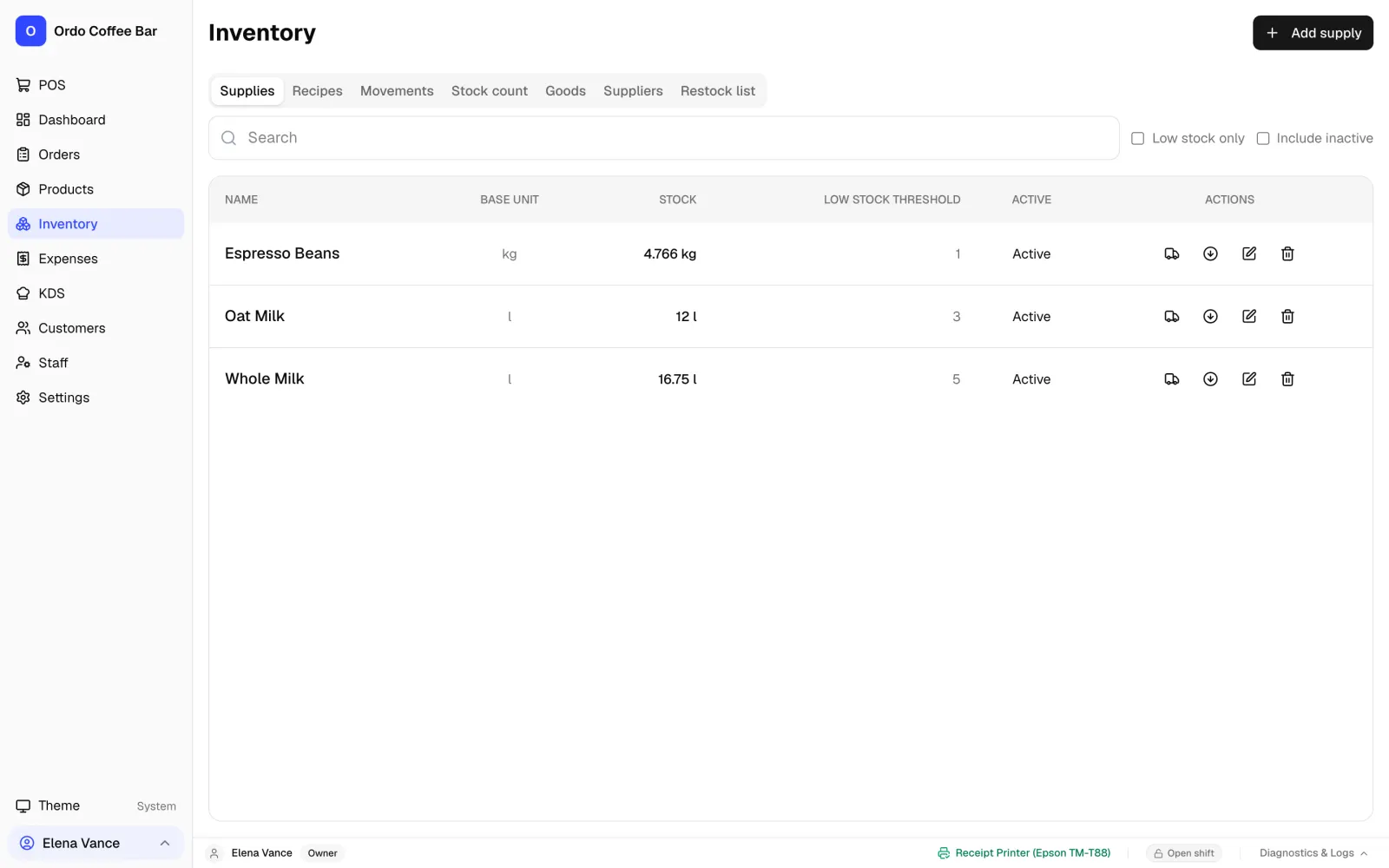
Ordo is a POS for coffee shops and small cafés with recipe-based stock built in. You enter how much coffee, milk, syrup and cups each item uses, and Ordo works out recipe cost from the purchase price of each ingredient. When a delivery arrives at a new price, the ingredient cost becomes the average of the stock on hand and the new batch. Each sale deducts ingredients by recipe and fixes its cost at the moment of sale, so old reports do not shift later. Drink sizes can carry a portion multiplier.
Write-offs and adjustments need a reason, and a stock count shows where shelf stock differs from the expected level. The dashboard shows ingredient cost, gross profit and margin for any period, and the sales export breaks it down by item. Ordo costs 1990 KGS a month for one café (about 23 US dollars) with every feature and any number of devices, and the first 14 days are free with no card. Ordo receipts are not fiscal; it works alongside your fiscal register.
How to use the calculator
The calculator sits right below this section, filled with the example numbers. Enter your bean price and dose, milk price and volume, cup and small items, and the menu price. For a raf or a plant-milk drink, put the cream or alternative milk into the milk fields and add syrup or sugar to the cup field.
Cost per cup calculator
FAQ
How do I work out the cost of a cup of coffee?
For each ingredient, divide the price per kilo or litre by 1000 and multiply by grams or millilitres per serving, then add the lines and the cup, lid and small items.
How much does a cappuccino cost to make?
It depends on your prices and recipe. With beans at 25 USD a kilo, an 18 g dose, 200 ml of milk at 1.20 a litre and 0.15 for the cup, it comes to 0.84 USD. Put your own numbers into the calculator on this page.
Is rent part of the cost per cup?
No. Cost per cup covers ingredients and consumables. Rent, wages and utilities are fixed costs; divide them by monthly cups to see the full cost of a drink and your break-even point.
What is the difference between markup and cost share?
Markup is how far the price is above cost, as a percentage of cost. Cost share is the part of the price spent on ingredients, as a percentage of price. A 300% markup equals a 25% cost share.
Why is real usage higher than the recipe says?
Milk left in the jug, grinder dial-in, staff drinks, write-offs and eyeballed doses. Record write-offs with a reason and count stock regularly against recipe usage to see the gap.
Is the calculator free?
Yes. You can use it as often as you like without signing up, and nothing you enter is sent anywhere.
Sources
- T—J (Tinkoff Journal): what goes into the price of a cup of coffee — checked 2026-10-29